
How Reliable Are Lie Detectors?
Lie detector tests raise a lot of questions, and rightly so. If you’re relying on the results for something important, you want to know the science actually holds up. This article looks at what a lie detector really measures, how accurate modern testing is, and where the doubts about reliability come from.
Is a Polygraph a Lie Detector?
Yes — a polygraph is one type of lie detector, but it isn’t the only one. So what is the polygraph exactly?
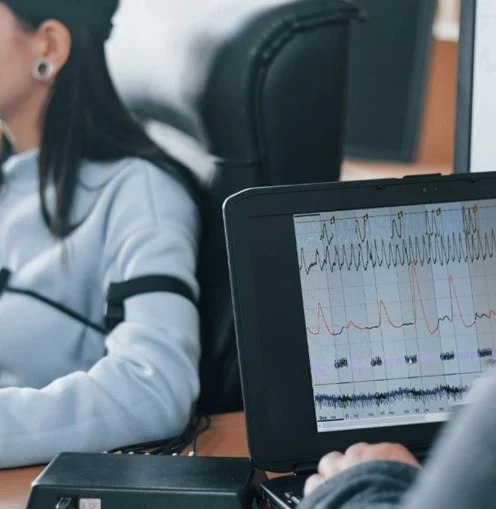
A traditional polygraph measures physical responses, like heart rate, blood pressure, breathing, and skin conductivity, while someone answers questions. The idea is that lying triggers small, involuntary body changes. The machine records those changes as they happen.
Newer technology takes a different approach. EyeDetect, for example, measures involuntary eye behaviour instead of these older physiological markers. It doesn’t rely on chest straps or arm cuffs at all. This is the polygraph’s biggest limit compared to modern tests.
- It depends on several sensors staying attached and calibrated during the session.
- This adds more chances for inconsistent results.
Both approaches share the same underlying principle: the body reacts to deception in ways a person can’t fully control. The difference lies in which signals get measured and how precisely they can be read.
Lie Detector Machine
A lie detector machine works by picking up on responses a person can’t consciously control. With a polygraph, sensors attach to the chest, fingers, and arm.
They send data to a machine that charts changes in real time. An examiner then reviews the charts and looks for patterns that suggest deception.
EyeDetect takes a more modern route. It’s completely non-invasive, using a high-speed camera to track eye movement and pupil behaviour. It uses this instead of physical sensors. There is no wiring or body attachment, which makes the experience much more comfortable for the person being tested.
The camera captures dozens of data points every second, well beyond what the human eye could ever track manually. That level of detail is a big part of why EyeDetect can offer such a consistent, repeatable result compared to older machines.
How Accurate Is a Lie Detector Test UK?
Accuracy is where most people focus their doubts, and it’s a fair question to ask. Traditional polygraph accuracy varies depending on the examiner, the equipment, and how the test itself is conducted.
Two examiners may review the same charts and reach different conclusions. This can raise concerns about polygraph test reliability when interpretation matters so much.
EyeDetect changes that picture. It delivers over 91% accuracy, one of the highest rates available in lie detection testing today. That level of consistency comes from removing human interpretation from the process.
The technology reads the data directly. It then generates a result using an algorithm which ultimately avoids relying on only an examiner’s judgement.
The examiner is registered with the World Association Of Professional Investigators, The Council Of International Investigators, and the UK Professional Investigators Network.
This matters in the UK, where people often use lie detector tests for personal, relationship, or work reasons. A high, consistent accuracy rate gives people real confidence in the outcome, whatever the test is being used for.
Most Accurate Lie Detector Test
When people ask how reliable are lie detectors. Compared to newer options, the answer usually favours EyeDetect. The test analyses eye movement patterns automatically, cutting out much of the subjectivity that affects older methods. There’s no waiting on one person’s interpretation of a chart.
This is also where accuracy of polygraph tests tends to fall short by comparison. Traditional testing relies on the examiner’s skill and experience. This can cause errors that vary between sessions. EyeDetect’s automated scoring eliminates that variable entirely, which makes it a major reason people consider it the more accurate option overall.
The test also takes far less time than a traditional polygraph session, without compromising on the quality of the result. For anyone comparing their options, that combination of speed and accuracy is difficult to overlook — and it’s a big part of why the accuracy of polygraph tests alone no longer tells the full story of what’s available today.
Are Lie Detectors Real?
Yes, lie detector tests are a genuine, established form of testing, not a gimmick or a novelty. They’ve been used for decades across personal, workplace, and legal contexts, and the underlying science behind measuring involuntary responses is well documented.
That said, it’s true that lie detectors are not accurate in every single case — no test claiming 100% accuracy should ever be trusted, and any provider that makes that claim should raise a red flag. What matters is choosing testing with a strong, proven track record, which is exactly what EyeDetect offers with its 91%+ accuracy rate.
Real, credible testing also means transparency about how the process works and what the results can and can’t tell you. Any honest provider will admit that lie detectors are not accurate 100% of the time, and will explain both sides clearly rather than overselling the technology.
Are Polygraphs Still Used?
Polygraphs remain in use today, particularly in specific professional and government settings where they’ve been part of standard procedure for many years. However, many providers have moved toward more advanced options like EyeDetect for everyday personal and workplace testing.
The shift makes sense. Newer technology offers higher accuracy, a faster process, and a far less invasive experience for the person being tested. There’s also less room for the kind of examiner-to-examiner variation that has long raised questions over “how reliable are lie detectors?” in everyday use.
That doesn’t mean polygraphs are gone. They are still a recognised method. Some organisations still rely on them.
But most people asking about polygraph testing today want something else. Modern options often seem more reliable. They also feel more comfortable.
Are Lie Detector Tests Reliable in Court?
Court reliability depends heavily on jurisdiction. In the UK, lie detector test results aren’t typically admissible as standalone evidence in criminal court, though they can support wider investigations or provide clarity in personal and workplace disputes outside a courtroom setting.
Even where results aren’t used as formal evidence, a strong accuracy rate still gives people confidence in the outcome. That’s exactly why the underlying reliability of the test itself remains important, regardless of its legal status. Many people use testing to settle a personal matter or gain peace of mind, rather than for court purposes at all.
How to Beat a Lie Detector Test
Some people search for ways to manipulate their results, often out of curiosity rather than genuine intent. In practice, this rarely works — and it’s not something we’d recommend trying under any circumstances.
EyeDetect measures involuntary eye responses that are extremely difficult to consciously control. Unlike a polygraph, controlled breathing or other tricks might affect the sensor readings.
But most people can’t convincingly fake eye movements or pupil behavior, even with lots of preparation.
Honesty remains the only reliable way to pass a lie detector test. Attempting to trick the system not only rarely succeeds, but it can also draw more attention to inconsistencies in the results rather than fewer — which is exactly why claims that lie detectors are not accurate rarely hold up under closer scrutiny.